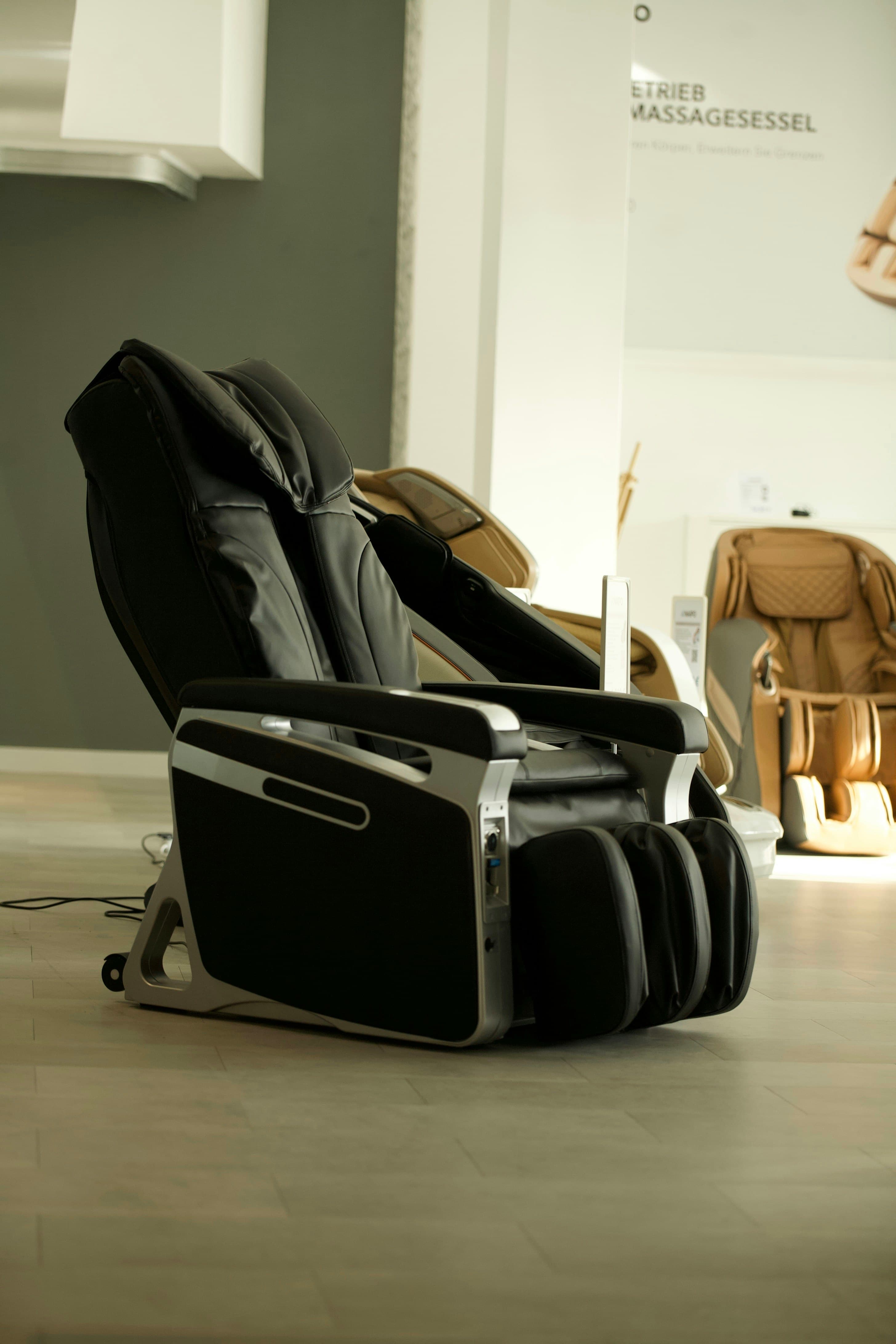
- Are massage chairs worth it?
- Conditionally, yes. Chiropractors and physical therapists describe them as legitimate supplementary tools (useful for daily muscle-tension relief, extending the benefit of professional treatment, and supporting circulation) but not a replacement for hands-on care for injury or chronic conditions. The value case is strongest for someone who would otherwise pay for regular professional massages and will use the chair several times a week. For occasional use, it is a weaker proposition, since the chair cannot adapt to a specific injury the way a human therapist can.
- What do 2D, 3D, and 4D rollers mean?
- 2D rollers move up/down and side to side (flat coverage). 3D rollers add depth: they protrude to press harder into the muscle. 4D adds variable speed and rhythm mid-stroke, which produces the most lifelike, human-like massage. In practice, the jump from a fixed-head or 2D chair to a real 3D/SL-track machine is the big one most people feel; 4D (as on the Osaki chairs here) is a genuine refinement that enthusiasts notice, but not essential for everyone.
- Why are massage chair prices so confusing?
- Because the category runs on inflated-MSRP discounting: chairs are listed at a fictional "was" price (often $12,999) and then "discounted" to their real street price. Two of our picks, the Osaki DuoMax and the Titan Jupiter LE, show wild price swings across retailers for the same chair. The honest approach is to ignore the crossed-out list price entirely and judge only what you would actually pay today. The Synca CirC and Real Relax are refreshing exceptions with more stable, honest pricing.
- Is an expensive massage chair worth it over a cheap one?
- Up to a point. Moving from a sub-$1,500 fixed-head chair to a genuine SL-track machine (like the ~$1,600 Real Relax) buys a real jump in massage quality; stepping up to a ~$5,000 4D chair (the Osaki Highpointe) buys lifelike rollers, better heat, sturdier build, and a longer warranty. But above roughly $8,000, the gains (dual-track, AI scanning) are real yet subject to steep diminishing returns. Notably, price does not track support quality: premium Osaki/Titan chairs draw more service complaints than some budget brands. The sweet spot for most people is the $2,000 to $5,000 range.